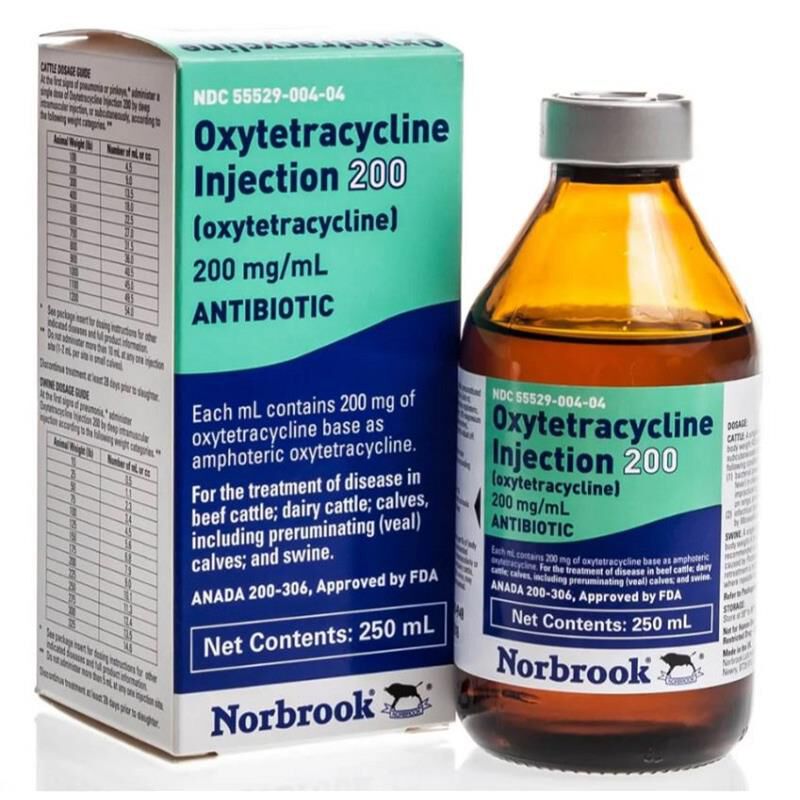
Oxytetracycline Injection 200 is intended for use in the treatment of the following diseases in beef cattle; dairy cattle; calves, including preruminating (veal) calves; and swine when due to oxytetracycline-susceptible organisms:
Cattle: Oxytetracycline Injection 200 is indicated in the treatment of pneumonia and shipping fever complex associated with Pasteurella spp. and Haemophilus spp.; infectious bovine keratoconjunctivitis (pink eye) caused by Moraxella bovis; foot rot and diphtheria caused by Fusobacterium necrophorum; bacterial enteritis (scours) caused by Escherichia coli; wooden tongue caused by Actinobacillus lignieresii; leptospirosis caused by Leptospira pomona; and wound infections and acute metritis caused by strains of staphylococci and streptococci organisms sensitive to oxytetracycline.
Swine: Oxytetracycline Injection 200 is indicated in the treatment of bacterial enteritis (scours, colibacillosis) caused by Escherichia coli; pneumonia caused by Pasteurella multocida; and leptospirosis caused by Leptospira pomona.
In sows, Oxytetracycline Injection 200 is indicated as an aid in the control of infectious enteritis (baby pig scours, colibacillosis) in suckling pigs caused by Escherichia coli.
Who is Oxytetracycline Injection 200 for Cattle and Swine for?
Cattle and Swine
Why use Oxytetracycline Injection 200 for Cattle and Swine?
Helps treat pneumonia, shipping fever, pink eye, foot rot, scours and wounds.
Norbrook
Oxytetracycline
How is Oxytetracycline Injection 200 for Cattle and Swine sold?
Sold in vials of 100 ml, 250 ml and 500 ml.
What are the side effects of Oxytetracycline Injection 200 for Cattle and Swine?
ADVERSE REACTIONS:
Reports of adverse reactions associated with oxytetracycline administration include injection site swelling, restlessness, ataxia, trembling, swelling of eyelids, ears, muzzle, anus and vulva (or scrotum and sheath in males), respiratory abnormalities (labored breathing), frothing at the mouth, collapse and possibly death. Some of these reactions may be attributed to anaphylaxis (an allergic reaction) or to cardiovascular collapse of unknown cause.
What special precautions are there?
PRECAUTIONS:
Exceeding the highest recommended dosage level of drug per lb of body weight per day, administering more than the recommended number of treatments, and/or exceeding 10 mL intramuscularly or subcutaneously per injection site in adult beef and dairy cattle, and 5 mL intramuscularly per injection site in adult swine, may result in antibiotic residues beyond the withdrawal period.
At the first sign of any adverse reaction, discontinue use of the product and seek the advice of your veterinarian. Some of the reactions may be attributed either to anaphylaxis (an allergic reaction) or to cardiovascular collapse of unknown cause.
Shortly after injection, treated animals may have transient hemoglobinuria resulting in darkened urine.
As with all antibiotic preparations, use of this drug may result in overgrowth of nonsusceptible organisms, including fungi. A lack of response by the treated animal, or the development of new signs, may suggest that an overgrowth of nonsusceptible organisms has occurred. If any of these conditions occur, consult your veterinarian.
Since bacteriostatic drugs may interfere with the bactericidal action of penicillin, it is advisable to avoid giving Oxytetracycline Injection 200 in conjunction with penicillin.
Contact your nearest emergency animal hospital.
How can I store Oxytetracycline Injection 200 for Cattle and Swine?
Store at controlled room temperature 20-25°C (68-77°F); excursions permitted 15-30°C (59-86°F). Protect from freezing. For 100 mL size: Use within 60 days of first puncture and puncture a maximum of 36 times. For 250 mL and 500 mL sizes: Use within 60 days of first puncture and puncture a maximum of 36 times. If using a needle or draw-off spike larger than 16 gauge, discard any remaining product immediately after use.
Oxytetracycline Injection 200 can also be administered by intravenous, subcutaneous, or intramuscular injection at a level of 3-5 mg of oxytetracycline per lb of body weight per day. In the treatment of severe foot rot and advanced cases of other indicated diseases, a dosage level of 5 mg/lb of body weight per day is recommended. Treatment should be continued 24-48 hours following remission of disease signs; however, not to exceed a total of 4 consecutive days. Consult your veterinarian if improvement is not noted within 24-48 hours of the beginning of treatment.
Swine: A single dosage of 9 mg of Oxytetracycline Injection 200 per lb of body weight administered intramuscularly in the neck region is recommended in the treatment of bacterial pneumonia caused by Pasteurella multocida in swine, where re-treatment is impractical due to husbandry conditions or where repeated restraint is inadvisable.
Oxytetracycline Injection 200 can also be administered by intramuscular injection at a level of 3-5 mg of oxytetracycline per lb of body weight per day. Treatment should be continued 24-48 hours following remission of disease signs; however, not to exceed a total of 4 consecutive days. Consult your veterinarian if improvement is not noted within 24-48 hours of the beginning of treatment.
For sows, administer once intramuscularly in the neck region 3 mg of oxytetracycline per lb of body weight approximately 8 hours before farrowing or immediately after completion of farrowing.
For swine weighing 25 lb of body weight and under, Oxytetracycline Injection 200 should be administered undiluted for treatment at 9 mg/lb but should be administered diluted for treatment at 3 or 5 mg/lb.
Each mL contains 200 mg of oxytetracycline
Reviews